

At a glance
- What it feels like
- Patients are described as feeling a brief heating sensation as the treatment tip touches the skin, followed by a cooling sensation meant to reduce discomfort. 2 · thermage.com
- Recovery & aftercare
- Thermage FLX is described as having little to no downtime, with no special aftercare required. 2 · thermage.com
- Typical course
- Thermage FLX is described as delivering results after a single treatment, unlike procedures that require multiple sessions. 2 · thermage.com
- Risk to ask about
- Some patients get temporary redness or minor swelling after treatment that usually goes away within 24 hours. 2 · thermage.com
- What it is
- During a Thermage FLX treatment, a handpiece delivers RF energy to the skin while built-in cooling and vibration are used to help with comfort. 2 · thermage.com
Thermage is one of the most talked-about monopolar radiofrequency (RF) treatments available at skin clinics in Korea, and it's often mentioned alongside HIFU devices like Ulthera and Shurink. Both aim to tighten skin, but published sources describe them as working through different physical mechanisms, with different session counts, pain profiles, and downtime. This guide compares what the available research and manufacturer information actually say about monopolar RF skin tightening — including Thermage FLX — and how it differs from HIFU-based devices.
How does monopolar RF skin tightening actually work?
Monopolar RF is described as a gentler, nonablative skin-tightening approach that delivers uniform heat to the dermis at a controlled depth[1 · pmc.ncbi.nlm.nih.gov]. Unlike cosmetic lasers, a monopolar RF device is described as producing an electric current rather than light[1 · pmc.ncbi.nlm.nih.gov]. During a Thermage FLX treatment specifically, a handpiece delivers this RF energy to the skin while built-in cooling and vibration are used to help with comfort[2 · thermage.com]. That heat is reported to cause direct collagen contraction, described as an immediate tightening effect[1 · pmc.ncbi.nlm.nih.gov]. Separately, research on monopolar RF describes dermal temperature reaching around 65°C, which is reported to partially denature collagen by breaking hydrogen bonds in its triple-helix structure[3 · pmc.ncbi.nlm.nih.gov]. After treatment, sources describe further collagen remodeling and new collagen formation continuing over months[1 · pmc.ncbi.nlm.nih.gov]. Your clinic can explain how this process is expected to unfold for your specific skin.
How is Thermage different from HIFU devices like Ulthera and Shurink?
The main sourced difference is depth and energy type. One source describes monopolar RF as targeting the upper reticular dermis, while HIFU is described as reaching the deeper reticular dermis and the superficial muscular aponeurotic system (SMAS) layer[3 · pmc.ncbi.nlm.nih.gov]. HIFU is described as using high temperature to cause cellular damage and volume reduction through coagulative necrosis[3 · pmc.ncbi.nlm.nih.gov], and as generating microthermal lesions in targeted tissue without damaging the epidermis or adjacent tissue[3 · pmc.ncbi.nlm.nih.gov]. Monopolar RF, by contrast, produces an electric current that heats the dermis directly, rather than relying on focused ultrasound[1 · pmc.ncbi.nlm.nih.gov]. This difference in depth and energy delivery is one reason clinics may lean toward RF, HIFU, or a combination depending on a person's skin and goals — a survey of dermatologists in South Korea reported that HIFU and RF were the most commonly used energy-based devices, often combined with injectable treatments[4 · pmc.ncbi.nlm.nih.gov]. Which option fits a particular case isn't something the sources used here give a single rule for, so it's worth discussing directly with the treating clinic.
How many sessions or shots does a monopolar RF treatment involve?
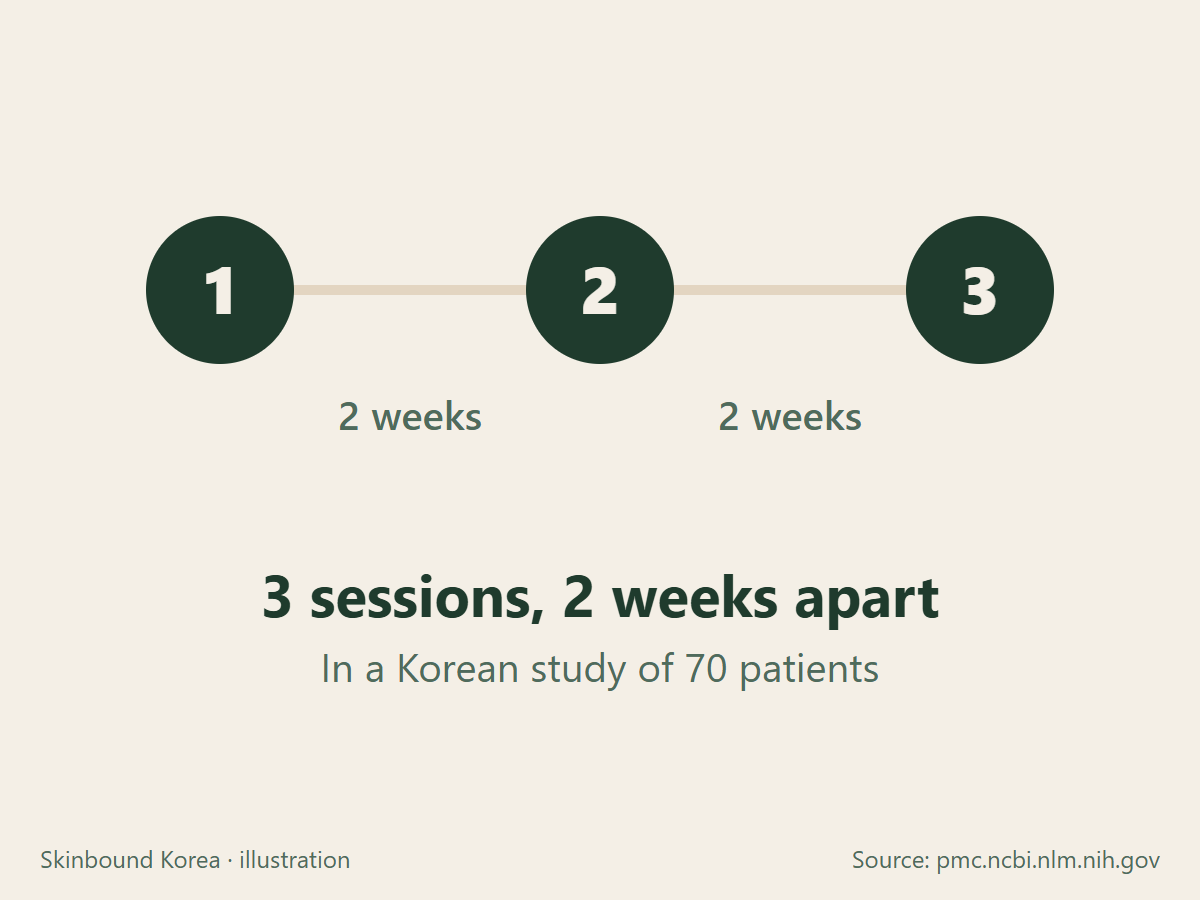
Thermage FLX is described by its manufacturer as delivering results after a single treatment, unlike procedures that require multiple sessions[2 · thermage.com]. Other monopolar RF research, however, used repeated sessions: in a small study, 6 women with photoaging underwent 6 monopolar RF sessions at 2-week intervals over 3 months[1 · pmc.ncbi.nlm.nih.gov], and in a separate Korean study, 70 patients with periorbital wrinkles each underwent three monopolar RF sessions spaced 2 weeks apart[5 · pmc.ncbi.nlm.nih.gov]. In that Korean study, each session delivered RF energy using 20 passes averaging 2.5 J per shot over a roughly 30×30mm area[5 · pmc.ncbi.nlm.nih.gov]. Shot counts for HIFU devices are reported differently: in a survey of South Korean dermatologists, 61.5% of respondents reported using high HIFU shot counts, typically over 450–600 shots, focused on the jowl and submental areas[4 · pmc.ncbi.nlm.nih.gov]. Session and shot numbers clearly vary by device, protocol and treatment area, so ask your clinic which numbers apply to the specific device and protocol they plan to use.
Does Thermage or monopolar RF treatment hurt?
Reported pain levels vary between sources. Thermage's manufacturer describes patients feeling a brief heating sensation as the treatment tip touches the skin, followed by a cooling sensation meant to reduce discomfort[2 · thermage.com]. In a separate Korean study of monopolar RF for periorbital wrinkles, pain during the procedure was reported as tolerable without any local anesthesia for all patients[5 · pmc.ncbi.nlm.nih.gov]. Because pain tolerance and comfort protocols differ between devices, energy levels and individuals, ask your clinic what to expect and whether numbing cream or other comfort measures are used during your session.
What's the downtime and what side effects can happen?
Thermage FLX is described as having little to no downtime, with no special aftercare required[2 · thermage.com]. Some patients get temporary redness or minor swelling after treatment that usually goes away within 24 hours[2 · thermage.com]. Swelling after monopolar RF treatment is described as typically resolving within 5 days, though it can remain for up to several weeks in some cases[2 · thermage.com]. In the separate Korean study of monopolar RF, reported side effects were mild and lasted approximately 1-3 days[5 · pmc.ncbi.nlm.nih.gov]. Manufacturer safety information also advises against Thermage treatment for people with a cardiac pacemaker, cardioverter, defibrillator, or other electrical implant[2 · thermage.com]. Because downtime and side effects can differ by device, energy level and individual skin, ask the treating clinic what to expect for you specifically and whether a follow-up check is recommended before you travel on.
How long are monopolar RF results reported to last?
For Thermage FLX, measurable results are described as appearing gradually over two to six months after a single session and lasting 1-2 years depending on the person's skin and aging process[2 · thermage.com]. Some patients notice initial tightening right after treatment, with visible improvement continuing over the following 2-6 months as collagen remodels[2 · thermage.com]. After treatment, sources describe further collagen remodeling and new collagen formation continuing over months[1 · pmc.ncbi.nlm.nih.gov]. These figures come from the device manufacturer and may vary with the specific device, protocol and individual — your clinic's protocol may differ, so confirm expected timelines with your doctor.
How should I plan travel around a monopolar RF session in Korea?
Because downtime for Thermage specifically is described as minimal[2 · thermage.com], and the side effects reported across sources — redness, swelling, mild discomfort — are generally temporary[2 · thermage.com][2 · thermage.com][5 · pmc.ncbi.nlm.nih.gov], many people may be able to continue a trip soon after a session. Even so, common planning advice for any energy-based skin treatment is to treat the day right after as a light observation day in the same city: avoiding a flight or long-distance travel, saunas, alcohol, intense exercise, or strong sun exposure, and asking the treating clinic whether a follow-up check is needed before you leave the area. Since healing speed and sensitivity vary from person to person, confirm your own timeline directly with the clinic that performs the treatment.
Things to discuss with your doctor
- Which device (monopolar RF, HIFU, or a combination) suits your skin type and goals, and why
- How many sessions, passes or shots are planned, and how that compares to the studies above
- What pain management or comfort measures are used during treatment
- What redness, swelling or other side effects to expect, and how long they typically last for you
- Whether a pacemaker, defibrillator or other condition could make treatment unsuitable for you
- How soon you can resume travel, exercise, sauna use or sun exposure after treatment
FAQ
Is Thermage the same as HIFU (Ulthera, Shurink)?
No — sources describe them as different technologies. Thermage uses monopolar RF, which produces an electric current and is described as targeting the upper reticular dermis[1 · pmc.ncbi.nlm.nih.gov][3 · pmc.ncbi.nlm.nih.gov], while HIFU devices use focused ultrasound and are described as reaching deeper into the reticular dermis and the SMAS layer[3 · pmc.ncbi.nlm.nih.gov][3 · pmc.ncbi.nlm.nih.gov]. Ask your clinic which technology fits your situation.
How many sessions of monopolar RF will I need?
It depends on the device and protocol. Thermage FLX is marketed as a single-treatment procedure[2 · thermage.com], while other monopolar RF studies used 3 to 6 sessions spaced about 2 weeks apart[1 · pmc.ncbi.nlm.nih.gov][5 · pmc.ncbi.nlm.nih.gov]. Confirm the specific protocol with your clinic.
Does the treatment hurt?
Reported pain varies by source. Thermage's manufacturer describes a brief heating sensation followed by cooling[2 · thermage.com], while a separate monopolar RF study found pain tolerable without local anesthesia[5 · pmc.ncbi.nlm.nih.gov]. Individual pain tolerance differs, so ask your clinic about comfort measures.
How much downtime should I expect?
Downtime is generally described as minimal. Thermage FLX is described as having little to no downtime[2 · thermage.com], with mild redness or swelling typically resolving within 24 hours to about a week depending on the source[2 · thermage.com][2 · thermage.com][5 · pmc.ncbi.nlm.nih.gov]. Your own recovery may vary — ask your clinic what to expect.
How long do results last?
For Thermage FLX, manufacturer information describes results appearing over two to six months and lasting 1-2 years depending on skin and the aging process[2 · thermage.com]. Individual results vary, so ask your clinic what to expect for your own skin.
This article was produced with AI assistance and is based on publicly available sources. It is not medical advice.
Sources
- Radiofrequency Facial Rejuvenation: Evidence-Based Effect Peer-reviewed
- Thermage FLX Official Patient and Technology Guide | Solta Medical
- Safety and Efficacy of High-Intensity Focused Ultrasound and Monopolar Radiofrequency Combination Therapy for Skin Tightening Peer-reviewed
- Real-World Clinical Practice on Skin Rejuvenation Among Korean Board-Certified Dermatologists: Survey-Based Results Peer-reviewed
- Usefulness of Monopolar Thermal Radiofrequency Treatment for Periorbital Wrinkles Peer-reviewed